
Paris covered passages: the walking tour starting from Galerie Véro-Dodat
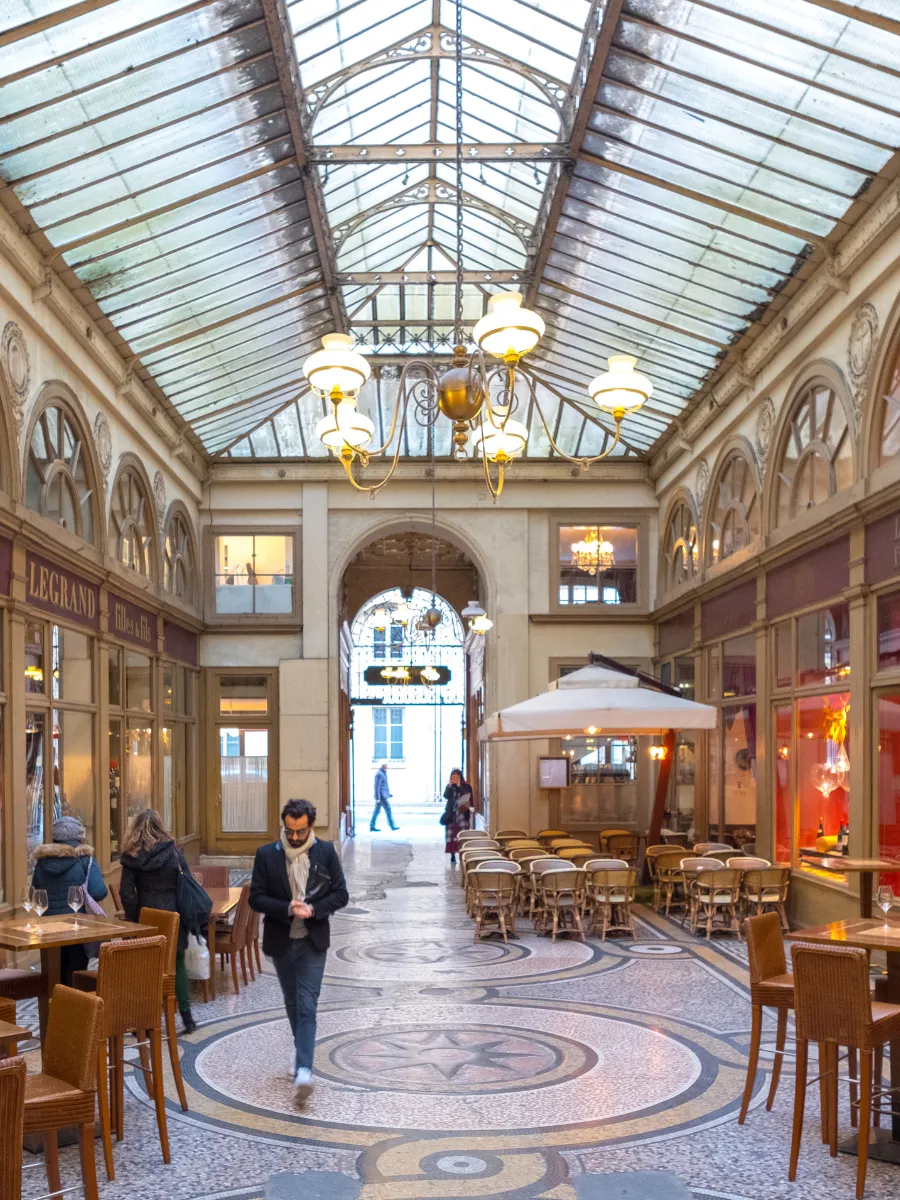
Paris once boasted over 150 covered passages in the 19th century; about twenty remain, almost all concentrated between the 1st, 2nd, and 9th arrondissements. This two-hour walking route connects seven of them, from the most pristine to the most vibrant, starting at the Galerie Véro-Dodat. No transport is needed; everything is within walking distance.
What is a covered passage?
These are private shopping arcades built between two streets, covered by a glass roof and lit by gas lamps: a Parisian invention from the 1800s, born from the need to shop without trudging through the mud. The grand boulevards and department stores eventually made them obsolete; about twenty have survived, several of which are classified as historical monuments.
The route, step by step
1. Galerie Véro-Dodat — 2 rue du Bouloi, 1st
Opened in 1826 by two butchers, Véro and Dodat, it is the best-preserved of them all: black and white checkered floors, original woodwork, mirrored panels, and glass globes. Today, it houses luthiers, galleries, and the Christian Louboutin workshop. Allow ten minutes to walk through it twice.
2. Galerie Vivienne — 4 rue des Petits-Champs, 2nd (8-minute walk)
The most spectacular, opened in 1823. Features mosaic floors by Facchina, a rotunda, and a double-revolution staircase. It is also the most popular: arrive early in the morning.
3. Galerie Colbert — 6 rue des Petits-Champs, 2nd (adjacent)
Its direct neighbor, built in 1826 to compete with it. It now belongs to the National Institute for Art History. Its rotunda and massive chandelier are worth a three-minute detour.
4. Passage Choiseul — 40 rue des Petits-Champs, 2nd (5 minutes)
The longest in Paris, opened in 1827. Céline spent his childhood here and described it in Death on Credit. Less of a museum piece and more commercial, with the Théâtre des Bouffes-Parisiens at the exit.
5. Passage des Panoramas — 11 boulevard Montmartre, 2nd (5 minutes)
The oldest: 1799. This is where gas lighting was first tested in Paris. Today, it is the best place to eat among the passages—wine bistros, wine merchants, and stamp shops coexist here.
6. Passage Jouffroy — 10 boulevard Montmartre, 9th (crossing the boulevard)
1845, and the first passage in Paris to have underfloor heating. It houses the historic entrance to the Grévin Museum, a travel bookstore, and the Hôtel Chopin, which has remained unchanged.
7. Passage Verdeau — 6 rue de la Grange-Batelière, 9th (1 minute)
The natural extension of the Jouffroy, opened in 1846. The quietest of the three: antique prints, second-hand cameras, and booksellers. It’s the perfect spot to end your stroll.
How long does the walk take?
Allow two hours without stopping, or three hours if you take your time to wander and grab a coffee. The route is about 2.5 kilometers long, entirely flat, and mostly covered, keeping you dry if it rains.
When should I go?
Weekday mornings between 10 a.m. and noon: the light streams through the glass roofs, the shops are open, and the passages are nearly empty. Most are closed on Sundays and some are gated at night, making the walk impossible in the evening.
A detour worth adding: Passage du Grand-Cerf
Ten minutes from the Panoramas, at 145 rue Saint-Denis, the Passage du Grand-Cerf features the highest glass roof in Paris—nearly twelve meters—and a cluster of designer workshops. It’s the most rewarding detour if you have an extra half hour.
Stay at the start of the walk
The route begins at Galerie Véro-Dodat, which opens onto rue du Bouloi. Hôtel Crayon is just a few meters from this exit, at 25 rue du Bouloi. A 3-star hotel with 26 unique rooms, furnished with vintage, repainted pieces: a logical extension of a walk dedicated to 19th-century Paris.
Other articles
FAQ
About twenty out of more than one hundred and fifty in the 19th century, concentrated mainly in the 1st, 2nd, and 9th arrondissements.
The Passage des Panoramas, opened in 1799 on the Boulevard Montmartre.
Most shops are closed on Sundays, and some passages are gated off at night. We recommend visiting on a weekday morning.
Yes, it is actually the best day to do it: a large part of the route is covered.